










Key Takeaways
White marble mosaic brings natural light, movement, and texture to both classic and contemporary interiors. The best result comes from balancing the stone’s character with the room’s scale, use, and maintenance needs.
- Compare marble varieties, veining, finishes, and mosaic shapes before ordering.
- Use polished stone for brightness and honed stone for a quieter, softer effect.
- Match the pattern and chip size to the room rather than choosing by trend alone.
- Plan for grout, cuts, waste, sealing, and wet-area performance from the beginning.
- Request samples and confirm lot variation before committing to a full installation.
Understanding white marble mosaic
White marble mosaic is made from small pieces of natural stone arranged on sheets or into custom patterns. It can soften a plain wall, add detail to a floor, or create a focused architectural moment without the visual weight of a large slab. Because every piece is natural, the finished surface has gentle variation instead of a perfectly repeated printed image.
What makes white marble mosaic distinctive
The appeal of white marble mosaic lies in its combination of reflection and texture. Small chips catch light differently from one another, while grout lines give the surface a subtle rhythm. The result can feel crisp and modern, or warm and traditional, depending on the pattern and finish.
For designers and homeowners, mosaic also offers flexibility around corners, niches, curved edges, and compact spaces. A carefully selected sheet can provide lasting visual character while remaining practical for backsplashes, shower floors, walls, and accent areas.
Popular white marble varieties and veining styles
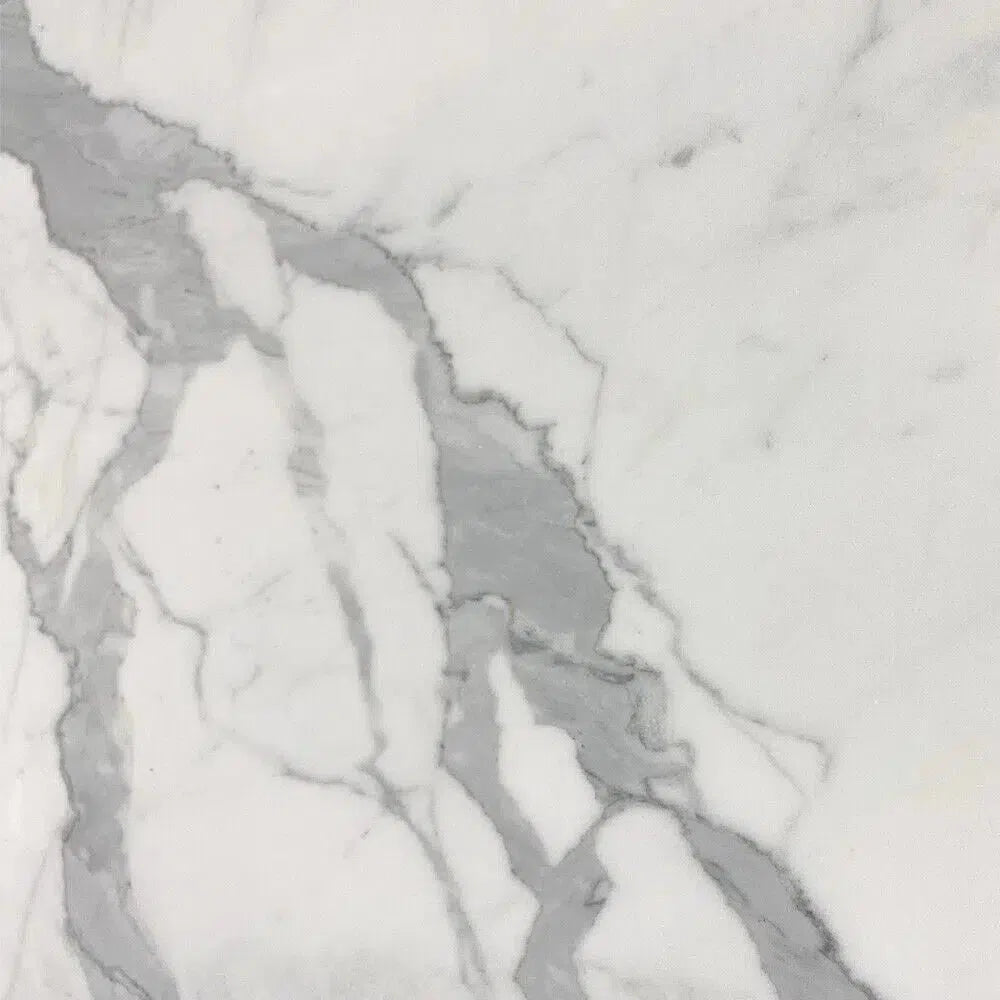
Carrara White is known for a white background with subtle gray veining, making it an easy choice for restrained kitchens and baths. Bianco Dolomite offers a pristine white field with delicate gray movement, while Thassos is recognized for its pure white color and crystalline structure. Statuario White brings a bolder look with dramatic gray veining.
The right variety depends on how much movement you want. Fine, cloudy lines recede into a calm room; broad veins become a design feature. Carrara marble is especially useful when you want a classic white-and-gray palette with options for tiles and mosaics.
How natural variation creates a one-of-a-kind look
Natural marble varies from piece to piece in tone, veining, and small mineral markings. That variation is part of its appeal, but it also means a sample cannot show every possible detail in a completed installation. Lay pieces from several sheets together before setting them to see how the movement will distribute.
Ask for the same lot whenever possible, especially for a large floor or a design with strong color matching. A little variation usually makes the surface feel more authentic; abrupt differences between lots can be more noticeable.
White marble mosaic tile versus large-format marble tile
Mosaic creates more grout lines and more visual texture, while large-format tile offers longer lines and a quieter field. Small pieces are often easier to arrange around drains, corners, and curved transitions, whereas large slabs or tiles can make an expansive wall feel calm and continuous.
The decision is not strictly about room size. A large bathroom may benefit from a mosaic shower floor for detail and drainage planning, paired with larger wall tile for visual simplicity. A narrow backsplash may feel more generous with a restrained mosaic and light grout.
Choosing the right mosaic pattern
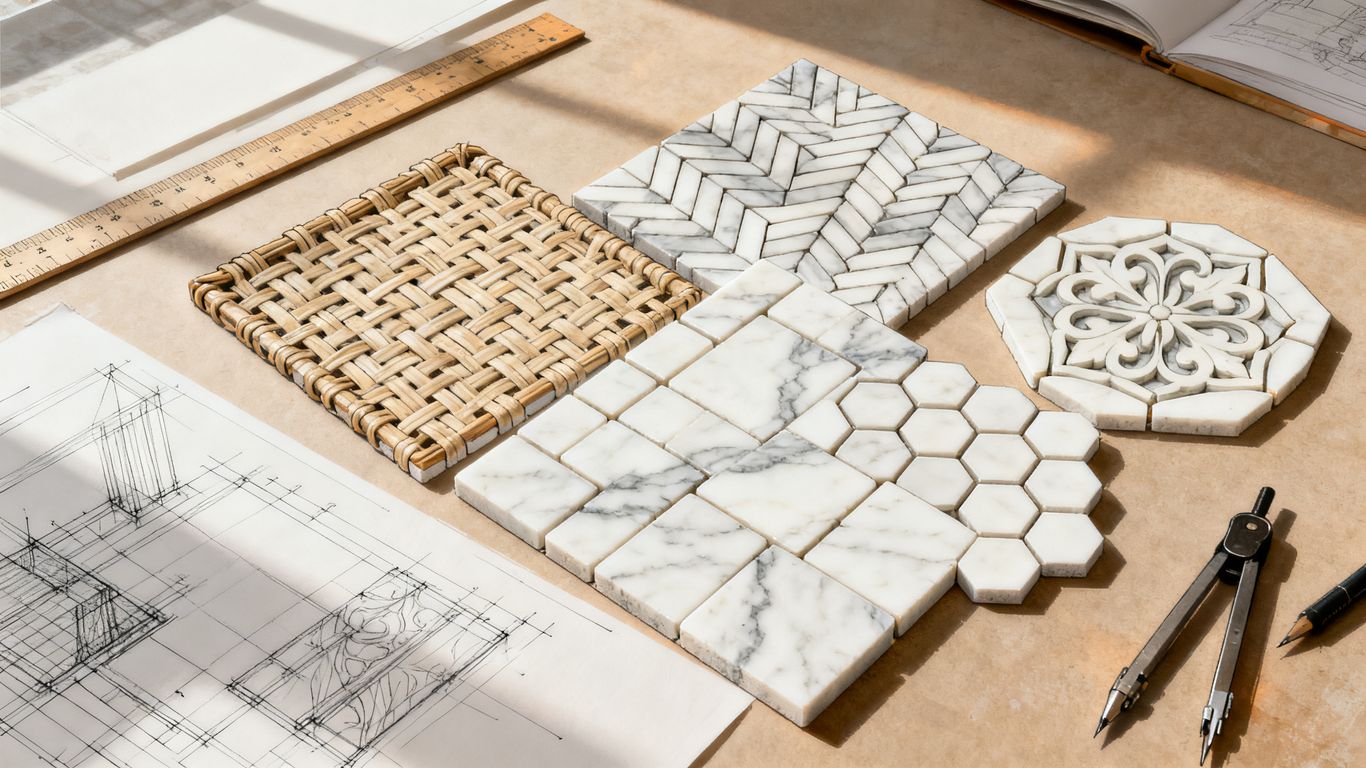
Pattern changes how white marble mosaic moves across a room. Repeated shapes can make a surface feel orderly, while directional layouts guide the eye along a wall or floor. Start by considering the architecture, then choose a pattern that supports rather than competes with it.
Basket weave and basketweave designs
Basket weave patterns combine small rectangular pieces with square insets to create a woven appearance. They suit traditional bathrooms, quiet entry floors, and backsplashes where you want detail without a busy border. The repeated structure feels established and balanced, particularly with softly veined marble.
A tonal grout keeps the pattern gentle. A contrasting grout makes every loop more visible, which can be attractive but may demand a more carefully coordinated room.
Herringbone and chevron layouts
Herringbone uses staggered pieces that change direction at regular intervals, giving a wall or floor a sense of movement. Chevron aligns the ends into a continuous point, producing a sharper and more tailored effect. Both layouts work well behind a range, in a shower niche, or on a narrow feature wall.
Directional patterns need accurate setting and consistent joints. If the room already has strong flooring, cabinetry, or architectural lines, use the pattern in a contained area rather than everywhere.
Hexagon, penny round, and arabesque shapes
Hexagons feel graphic and contemporary, while penny rounds bring a softer, playful rhythm. Arabesque shapes add a curved silhouette that can make a backsplash or powder room more decorative. The shape should echo something already present in the room, such as rounded hardware, arched openings, or simple geometric cabinetry.
A restrained white marble keeps these shapes from feeling overly ornamental. For a polished Oriental White mosaic, Oriental White mosaic offers a classic small-chip appearance suited to walls, floors, and residential or commercial settings.
Geometric, floral, and waterjet mosaics
Geometric, floral, and waterjet designs are best treated as focal points. They can frame a niche, center a foyer, or sit behind a vanity where the eye naturally pauses. Intricate cuts reward a quiet surrounding field and careful alignment.
Use a full pattern only when the room can carry it. Otherwise, a decorative inset or border can provide the same sense of craftsmanship with less visual competition. Marble mosaic tile is a useful starting point when comparing shapes, patterns, and finishes across a broader selection.
Selecting a finish, color, and size
Finish affects both the way marble reflects light and the way it feels under hand or foot. Color affects how the mosaic relates to cabinets, paint, metal, and wood. Size determines whether the pattern reads as a quiet texture or a dominant feature.
Polished marble for brightness and visual impact
Polished marble has a smooth, reflective surface that can brighten a dim backsplash or make a compact powder room feel more luminous. Its clarity brings out veining and gives decorative patterns a dressier presence. It is often effective on walls and backsplashes where visual impact matters most.
Because reflection can highlight unevenness, the substrate and installation should be carefully prepared. Samples should be viewed under the actual room’s lighting, not only under showroom lights.
Honed marble for a softer, matte appearance
Honed marble has a low-sheen surface with a quieter, more tactile appearance. It works naturally with relaxed kitchens, spa-like bathrooms, and interiors built around wood, linen, or brushed metal. Small variations can appear gentler when the surface is matte.
Honed does not mean maintenance-free. Marble remains a porous, acid-sensitive natural stone, so sealing and prompt cleanup still matter. The finish is a visual choice, not a substitute for care.
Matching white marble with gray, beige, or dark accents
Gray accents reinforce cool veining and create a clean architectural palette. Beige, cream, and warm wood pull white marble toward a softer, more welcoming mood. Dark accents, including black fixtures or deep cabinetry, create contrast and make the white stone feel especially bright.
Use the marble’s dominant undertone as the bridge. A warm white can sit comfortably beside brass and oak, while a cooler white may pair more naturally with chrome, gray paint, and pale concrete.
Choosing mosaic dimensions for scale and proportion
Chip size should relate to the room and the distance from which it will be viewed. Tiny mosaics create frequent joints and fine texture; larger pieces make the pattern easier to read from across a room. Sheet dimensions also affect how efficiently the material fits around edges and openings.
| Mosaic scale | Visual effect | Common design use | Planning consideration |
|---|---|---|---|
| Small chip | Detailed and textured | Shower floors, niches | More grout and more joints |
| Medium chip | Balanced and versatile | Backsplashes, powder rooms | Easy pattern recognition |
| Large chip | Calm and open | Feature walls, broad floors | More visible cuts at edges |
| Custom mix | Tailored and distinctive | Insets and focal areas | Requires careful approval |
Use the table as a starting point, not a fixed rule. A medium mosaic may feel perfect in a compact backsplash but too restrained on a large entry floor; always test the layout with a physical sample.
Applying white marble mosaic throughout the home
A white marble mosaic can travel from a kitchen to a bathroom and still feel coherent when the finish, undertone, or grout color creates a visual connection. It can be the main surface or a smaller accent that gives an otherwise simple room its identity. Choose each application according to water exposure, traffic, cleaning habits, and sightlines.
Kitchen backsplashes and behind-range installations
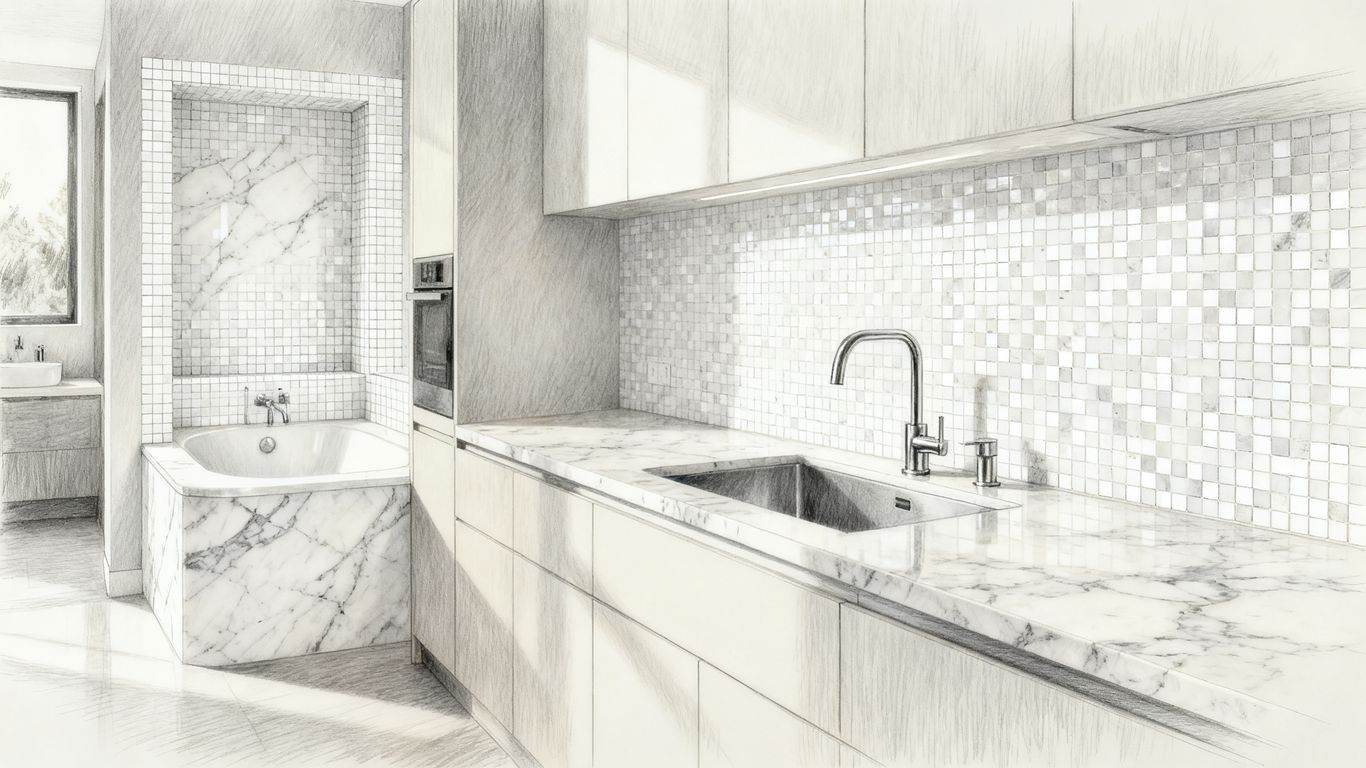
A mosaic backsplash adds texture between countertop and cabinet, while a behind-range installation can act as a framed focal area. Polished Carrara or a softly veined white marble suits many cabinet colors, from painted white to natural walnut. Keep the field calm if the countertop already has dramatic movement.
Behind a range, plan for cooking splashes and access to cleaning. A well-sealed surface and compatible grout are as important as the pattern itself. For a wider look at Carrara options, the Carrara White collection can help frame decisions about tile, mosaic, and finish.
Bathroom floors, shower walls, and shower niches
Mosaic is especially useful on shower floors because smaller pieces can follow the plane toward a drain and provide frequent joints. On shower walls, it can cover the full surface or define a vertical niche. A honed finish often creates a softer visual experience, but slip resistance must be evaluated for the exact product and setting.
Use a compatible waterproofing system behind the tile and slope wet floors correctly. Niches deserve extra attention: align their borders with the surrounding pattern so the detail looks intentional rather than cut in afterward.
Powder rooms, entryways, and feature walls
Powder rooms can carry a more decorative pattern because they receive less daily water and often have a compact footprint. In entries, a durable natural stone mosaic can establish the tone of the home, while a feature wall gives a living area or hallway a crafted focal point.
For a patterned floor, repeat the marble’s lighter tone elsewhere through paint, trim, or furnishings. The room will feel designed as a whole instead of divided into unrelated surfaces.
Fireplaces, accent areas, and commercial interiors
Marble mosaic can frame a fireplace, define a bar, or add texture to a boutique hospitality or retail interior. Dramatic contrast can be effective in a commercial setting, while residential fireplaces often benefit from quieter veining and a broader border.
Use materials appropriate to the installation and follow local requirements around heat, moisture, and structural support. Custom mosaics can be made for backsplashes, walls, floors, and custom designs; a collection using materials such as Calacatta Gold, Carrara, Ming Green, and Bardiglio offers room for both restrained and expressive compositions.
Planning installation and performance
Beautiful stone still needs a sound installation plan. Before ordering, confirm the substrate, dimensions, transitions, edge details, waterproofing, and setting materials with the installer. This avoids the common mistake of treating mosaic as a decorative purchase rather than a complete surface system.
Evaluating slip resistance for wet areas
Do not judge wet-area safety from a photograph or finish name alone. Ask about the exact tile, finish, intended use, and applicable testing, then discuss the choice with a qualified installer. A small mosaic may offer more joints than a large tile, but the overall performance depends on the complete installation.
Bathrooms also need correct drainage, a properly sloped substrate, and grout suited to the exposure. These practical details should be settled before pattern selection becomes final.
Preparing the surface and planning the layout
The surface must be clean, stable, flat enough for the selected tile, and appropriate for the setting system. Dry-lay several sheets to inspect color distribution, sheet seams, focal points, and the relationship to corners. Mark a centerline or another logical starting point rather than beginning wherever the first box happens to land.
A small planning checklist keeps the visual decisions connected to the construction work:
- Confirm wall or floor flatness and moisture conditions.
- Identify the most visible starting points and finished edges.
- Dry-lay sheets to review veining and pattern continuity.
- Coordinate trim, transitions, niches, and drain locations.
After the dry layout, photograph the arrangement and label pieces if the pattern is intricate. This simple step can save time when the installer begins setting the final sheets.
Choosing grout color and joint width
Grout can disappear into a pale marble or outline every piece. A close match creates a continuous surface, while a gentle gray can clarify basket weave, herringbone, or hexagon shapes. Strong contrast is best used deliberately because it becomes part of the room’s graphic design.
Joint width should follow the tile manufacturer’s guidance and the installer’s assessment of the actual pieces. Natural stone mosaics may have small dimensional differences, so forcing an ultra-tight joint can make alignment harder rather than more refined.
Accounting for cuts, waste, and pattern alignment
Order enough material for cuts, breakage, directional matching, and future repairs. Intricate patterns generally require more planning than a simple field, especially around outlets, corners, doors, and plumbing fixtures. Review the quantity with the installer using measured conditions rather than relying only on a room’s rough square footage.
Confirm whether all boxes come from one lot and keep a small reserve after installation. Natural stone and availability can change, and a retained sheet may be valuable for a later repair.
Maintaining white marble mosaic over time
Marble rewards routine care more than occasional aggressive cleaning. Dust, cooking residue, soap, and standing water should be removed with methods suited to natural stone. A consistent routine helps preserve the white background and keeps grout from becoming the most noticeable part of the installation.
Sealing marble before and after installation
Sealing is usually considered before grouting and again after installation, but the exact schedule depends on the stone, finish, grout, and product instructions. Have the installer confirm compatibility and test a small area first. Sealer reduces absorption; it does not make marble immune to stains or etching.
A maintenance record is useful for busy households and commercial spaces. Note the products used, installation date, and any recommended resealing interval.
Cleaning products and methods to use
Use a pH-neutral cleaner made for natural stone, a soft cloth or mop, and clean water where appropriate. Wipe spills rather than spreading them across the mosaic, and rinse away cleaner residue. Avoid abrasive pads and household acids that may dull or etch the surface.
If a mark does not lift with gentle cleaning, stop before escalating to a stronger product. A stone-care professional can identify whether the issue is residue, staining, etching, or grout discoloration.
Preventing stains, etching, and discoloration
Use coasters, mats, and prompt cleanup in areas exposed to oils, cosmetics, wine, coffee, or metal objects. In showers, ventilation and regular drying reduce soap buildup and lingering moisture. Avoid leaving damp cloths or rubber-backed items against the marble for long periods.
White marble is particularly revealing when care is neglected, but its natural variation can also disguise minor changes. Prevention remains simpler and less expensive than trying to restore a damaged finish.
Repairing damaged or uneven mosaic pieces
A chipped or uneven piece can sometimes be replaced without rebuilding the entire installation. Keep spare sheets, photograph the original arrangement, and ask an experienced installer to remove the damaged piece without disturbing its neighbors. Matching may be imperfect if the material came from a different lot.
For dull patches or etching, surface treatment may be needed rather than replacement. Diagnose the problem first; polishing a stain or sealing over residue will not solve the underlying cause.
Buying premium white marble mosaic with confidence
Premium does not mean choosing the most dramatic stone or the highest price. It means understanding the material, reviewing its variation, confirming its intended use, and buying enough for the installation. A trustworthy supplier should be willing to discuss samples, finish, lot, lead time, and practical installation questions.
Comparing authentic natural stone and imitations
Real marble has mineral movement, tactile variation, and a surface character that changes subtly across pieces. Imitation products may offer consistency and a different maintenance profile, but they should not be described as natural stone. Ask for clear material information, finish details, thickness, sheet dimensions, and care guidance.
For a natural-stone project, authentic natural stone is a helpful phrase to keep in mind when comparing product descriptions. The goal is not simply a white appearance; it is selecting a surface whose behavior and character suit the room.
Reviewing samples, finishes, and lot variation
Order samples in the finish and size you intend to use, then view them beside cabinetry, paint, counters, hardware, and flooring. Look at the stone in daylight and at night. Turn several pieces over to understand how sheets are assembled and where seams may appear.
When possible, approve a representative range rather than one ideal chip. A sample should help you understand the material’s possibilities, not promise that every piece will be identical.
Ordering the right quantity for your project
Measure each area separately and identify where the pattern will turn, terminate, or meet another material. Add a sensible allowance for cuts and breakage, with a larger allowance for complicated layouts or fragile pieces. Confirm box coverage, nominal dimensions, and whether the supplier sells by sheet, piece, box, or square foot.
For U.S. projects, nationwide shipping can make sourcing easier, but delivery timing and inspection still need attention. Open shipments promptly, document damage, and resolve concerns before installation begins.
Why work with a direct marble tile importer
A direct importer can connect customers with natural stone brought from international quarries, while also providing guidance for homeowners, contractors, architects, and designers. American Stone Center describes itself as a direct importer serving projects across the United States, with nationwide shipping and a focus on authenticity, value, and support.
That relationship is most useful when the supplier can answer straightforward questions about product identity, variation, quantity, and application. For additional visual planning, a marble design guide may be a useful pause between selecting the stone and finalizing the room; the design process is easier when decisions are made with enough time to review samples and layouts.
Conclusion
The right white marble mosaic is a balance of natural character, pattern, finish, scale, and practical performance. Compare real samples, plan the installation carefully, and choose a supplier that can support the project from selection through delivery and care. With those decisions in place, marble mosaic can bring a polished yet personal finish to kitchens, bathrooms, entries, feature walls, and commercial interiors.
Frequently Asked Questions
Is white marble mosaic suitable for bathroom floors?
It can be suitable when the exact product, finish, grout, waterproofing, slope, and installation are appropriate for the wet area. Ask the installer to evaluate slip resistance and the complete surface system rather than relying on color alone.
Which white marble is the brightest?
Very white stones such as Thassos can create a particularly clean appearance, while polished finishes reflect more light. Lighting, veining, grout, and surrounding materials also affect how bright the finished mosaic looks.
Should white marble mosaic be polished or honed?
Polished marble offers more reflection and visual impact, while honed marble has a softer matte appearance. The best choice depends on the room, desired mood, maintenance expectations, and whether the surface is underfoot or primarily decorative.
What grout color works with white marble mosaic?
A grout close to the marble’s background creates a quieter, more continuous surface. A soft gray can reveal the pattern without creating the strong outline produced by a much darker grout.
How much extra mosaic should be ordered?
The allowance depends on room shape, pattern complexity, cuts, breakage, and whether material must be matched across lots. Have the installer calculate the quantity from measured conditions and retain spare material for future repairs.
Can marble mosaic be used behind a kitchen range?
Yes, it is commonly considered for backsplash and behind-range areas, provided the selected stone, grout, setting materials, and cleaning plan suit the exposure. Confirm the installation details with a qualified professional.
How do you clean white marble mosaic?
Use a pH-neutral natural-stone cleaner and a soft cloth or mop, then remove spills promptly. Avoid acids, abrasive products, and harsh household cleaners that can etch or dull marble.
How do I order project guidance for a stone installation?
Start by gathering room measurements, photos, finish preferences, and application details, then request samples and review the layout before purchasing. Clear information makes it easier to compare options and plan delivery.
Find Your Marble
Explore natural marble and mosaic options with American Stone Center for U.S. renovation and design projects. Request samples, review your quantities, and speak with the team about a finish and layout suited to your space.